Does this sound familiar? “I want to tear out my carpet and expose the beautiful hardwood floors, but I do not want to walk around on hard, cold floors. What do I do?” Well, look no further. Rugs are an easy way to add texture, pattern, and color to any room in your house. Before you buy one, though, it helps to know what it is made of. This guide walks through the main types of rug materials, what each fiber actually is, and how that fiber affects durability and care.
Knowing your fiber matters because two rugs can look almost the same and behave very differently. One might shrug off spills. Another might stain or fade fast. Let’s break down the fibers one by one.
Why the fiber matters more than the pattern
The material is the part of a rug you cannot see at a glance, but it drives everything else. It sets how long the rug lasts, how it handles foot traffic, and how you have to clean it.
Here is what the fiber decides for you:
- How durable the rug is under daily wear
- How well it resists stains, sun, and moisture
- How gentle you have to be when you vacuum
- How often it needs a professional cleaning
If you only shop by color and pattern, you can end up with a beautiful rug in the wrong spot. Match the fiber to the room first, then pick the look.
Wool, the classic natural rug fiber
Wool is one of the most common rug materials, and for good reason. Its soft texture makes it the perfect complement to your smooth wood or tile floors. Wool comes from sheep, so it is a natural animal fiber, and rugs made from it are durable and traditionally handwoven.
What to know about wool:
- It is soft, warm, and very durable
- It sheds a lot during the first few months, which is normal and usually mellows out
- Frequent vacuuming keeps the pattern looking sharp during that early shedding stage
- It holds up well in busy rooms
Regular vacuuming is the best way to maintain your wool rug’s beautiful pattern (Leverette, 2019). You should get a wool rug professionally cleaned every 1 to 2 years to keep its luster, but take it in right away if you get a deep set stain. Fun fact: Wool from Merino sheep, in New Zealand and Australia, is considered the highest quality for rug-making because of its softness (Amirkhan and Groseclose, 2010).
Silk, the delicate luxury fiber
Silk is a unique material that has been used for many purposes in the textile industry, including rugs. It is a natural fiber spun by silkworms, and it has a soft sheen that catches the light.
Silk at a glance:
- It has surprisingly high tensile strength, so the fibers will not break when stretched
- It is still vulnerable to abrasions, so it belongs in low foot-traffic areas
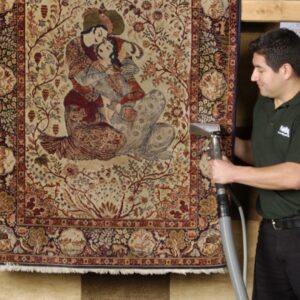
- Some people even hang silk rugs as wall decor so they last longer (Shadkam, n.d.)
- It needs a gentle touch
Because silk rugs are delicate, be gentle while vacuuming and take them to a professional cleaner every 2 to 3 years to prevent dirt buildup. Fun fact: Silk is said to have been discovered by a Chinese empress who accidentally dropped a silkworm cocoon into her cup of tea. According to legend, the cocoon unraveled to reveal a single thread, and thus came silk (Amirkhan and Groseclose, 2010).

Cotton, the affordable everyday fiber
Cotton is another material used for rugs, and it is a natural plant fiber. Cotton is less expensive than wool or silk, so these rugs are considerably more affordable.
Why people choose cotton:
- It is budget-friendly compared to wool and silk
- It is durable and easy to clean, and many cotton rugs are machine washable
- It is vulnerable to sun damage, so keep it out of direct sunlight
- It works well in casual, everyday rooms
Although cotton rugs are more durable than silk and wool, you should still get them professionally cleaned every 2 to 3 years. The professional cleaners will fully wash the rug and remove dirt embedded in the fibers, since that grit can wear the rug down. Fun fact: Scientists are working on genetically engineering cotton to naturally produce different colors, such as purple and black. That would make colored cotton rugs more eco-friendly, since the dyeing process can be harmful depending on the type of dye companies use (Segran, 2020).
Jute, sisal, and other natural plant fibers
Beyond cotton, many rugs are woven from plant fibers like jute, sisal, and seagrass. These are natural fibers harvested from plants, and they give a rug a rough, earthy, textured look.
What sets plant fibers apart:
- They have a coarse, natural texture that suits casual and coastal styles
- Jute is softer, while sisal is tougher and better for high traffic
- They do not handle water well and can stain or warp if soaked
- They usually need dry cleaning methods rather than heavy washing
Because these fibers dislike moisture, they are best kept in low-humidity, low-spill areas. Blot spills quickly and lean on gentle, low-water cleaning to protect the weave.
Synthetic fibers, from nylon to polyester
Rugs are increasingly made of synthetic materials. These include nylon, polypropylene, and polyester (Amirkhan and Groseclose, 2010). Synthetic fibers are man-made, which keeps them affordable and widely available.
The trade-offs with synthetics:
- They resist sun damage and mildew and mold well
- They are more prone to stains, especially oil-based ones (Colley, 2010)
- They do not hide dirt very well, so they show grime sooner
- They can break under harsh scrubbing, so vacuum with care
It is still smart to have synthetic rugs professionally cleaned, since they are vulnerable to breakage from rough scrubbing. Because they show dirt, plan on a cleaning about once a year. Many wall-to-wall carpets use the same nylon and polyester fibers, which is why a synthetic rug responds to the same gentle care as our carpet cleaning work. Fun fact: Since synthetic fibers are inexpensive compared to other materials, rug makers use them to make affordable rugs with oriental designs (Amirkhan and Groseclose, 2010).
How to tell what your rug is made of
Not sure which fiber you have? A few simple checks can point you in the right direction.
- Feel the pile: wool is springy and soft, silk is smooth and cool, jute and sisal feel coarse
- Look at the back: handwoven wool and silk often show a knotted, detailed back, while synthetics look uniform and machine-made
- Check the sheen: silk has a natural shimmer that shifts with the light
- Read the label or ask the seller when you can, since guessing wrong can lead to the wrong cleaning method
When you are unsure, treat the rug as delicate until you know for certain. A professional can inspect the material, dyes, and wear pattern and tell you exactly what you are working with.
How the material changes cleaning and care
Every fiber has its own care needs, and this is where knowing your material pays off. A method that is safe for cotton can ruin silk, and too much water can wreck a jute rug. That is why the right care starts with the right identification.
Quick care recap by fiber:
- Wool: vacuum often, professional clean every 1 to 2 years
- Silk: vacuum gently, professional clean every 2 to 3 years
- Cotton: easy to clean, professional clean every 2 to 3 years
- Plant fibers: keep dry, use low-water methods
- Synthetics: clean about once a year since they show dirt
For hands-on care by fiber, our local teams handle every material with methods matched to the weave. You can learn more about rug cleaning in Ventura, rug cleaning in Santa Barbara, and Thousand Oaks rug cleaning.
The bottom line on rug materials
Once you can name your fiber, every other choice gets easier.
- Wool and silk are natural, durable, and worth gentle handling
- Cotton and plant fibers keep things affordable and casual
- Synthetics resist sun and mildew but show dirt faster
- The fiber, not the pattern, decides how you clean and protect the rug
Kelly Cleaning uses state of the art technology and never harsh chemical washes to care for all types of rug materials. When your rug is ready for a deep clean, see our rug cleaning service for Ventura and Santa Barbara counties, or call (805) 644-5308.
References
- Amirkhan, E., and Groseclose, A. (2010). A Comprehensive Guide to Oriental and Specialty Rug Cleaning (2nd ed.). Master Rug Cleaner, LLC.
- Colley, A. S. (2010). Natural Vs. Synthetic Rugs, What are the PROs and CONs. A C Styles Designs, LLC.
- Leverette, M. M. (2019). How to Clean a Wool Rug. The Spruce.
- Segran, E. (2020). Scientists are growing psychedelic cotton in the lab. Fast Company.
- Shadkam, R. (n.d.). Silk Rugs Vs. Wool Rugs. Catalina Rug.